SELECTRA
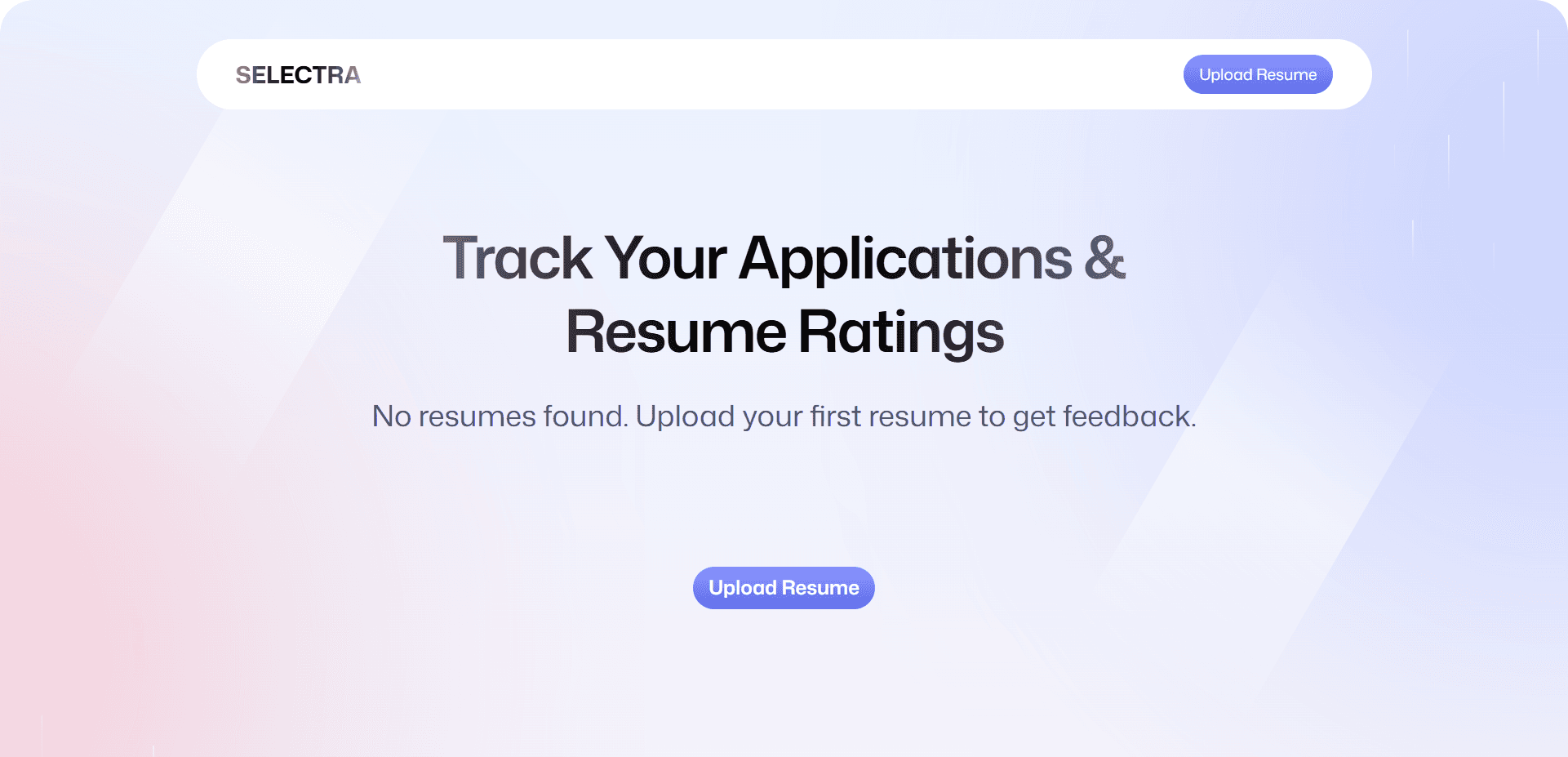
An AI-powered ATS resume optimization platform that performs client-side PDF rasterization and LLM-driven keyword analysis to improve job application success rates.
The Challenge
- Performing memory-efficient PDF parsing and rasterization entirely on the client side to minimize server bandwidth and ensure data privacy.
- Engineering deterministic, strictly structured JSON responses from the OpenAI API despite processing highly unstructured resume text.
- Managing complex, multi-step asynchronous states (uploading, parsing, inferencing, saving) without degrading UI responsiveness.
Key Learnings
- Mastered the implementation of Web Workers for off-main-thread processing using PDF.js.
- Deepened expertise in global state management and re-render optimization utilizing Zustand.
- Gained hands-on experience integrating persistent Key-Value cloud storage (Puter) into a serverless frontend architecture.
The Problem Space
Modern recruitment relies heavily on Applicant Tracking Systems (ATS) to filter candidates. Unfortunately, highly qualified engineers are frequently auto-rejected not for a lack of skill, but due to poor resume parsing, formatting errors, or missing semantic keywords.
Job seekers needed a tool that didn't just passively "score" their resume, but actively simulated an ATS parser and provided actionable, context-aware feedback based on specific job descriptions. SELECTRA was architected to bridge this gap.
Core Features & UX
SELECTRA is designed to be frictionless. By eliminating the need for user authentication just to analyze a document, the time-to-value is reduced to seconds.
- 🔍 AI-Powered Analysis: Generates deterministic, strictly structured feedback based on the user's target job title and specific job description.
- 📁 Smart File Processing: Features a drag-and-drop interface supporting multiple file formats, instantly converting PDFs to high-quality PNGs for visual preview.
- 📊 Actionable Reporting: Breaks down the LLM inference into a comprehensive UI, highlighting exact missing keywords and formatting bottlenecks.
- 💾 Edge Persistence: Integrates a secure Key-Value cloud storage system, allowing users to save and revisit their analysis results without a traditional backend.
Architectural Deep Dive
SELECTRA is built as a highly responsive Single Page Application (SPA) designed around a serverless, client-first architecture. By offloading heavy processing tasks directly to the user's browser, the application achieves zero-latency file uploads and strict data privacy.
The application pipeline is broken into three distinct engineering phases:
1. Client-Side Rasterization via Web Workers
Sending multi-megabyte PDFs to a Node.js backend for parsing introduces network latency, server costs, and privacy concerns.
Instead, SELECTRA utilizes pdf.js alongside Web Workers (pdf.worker.min.js). The application extracts the raw text stream and generates high-fidelity PNG rasterizations entirely on a background thread. This keeps the main React UI thread completely unblocked and running at 60fps during the computationally expensive canvas rendering phase.
2. Deterministic LLM Inference
Integrating with the OpenAI API required strict prompt engineering to ensure the UI received actionable data rather than raw text blocks.
The LLM is configured to act as a strict JSON parser. It evaluates the candidate's extracted text against the target job description, calculates a deterministic match score, and returns categorized arrays of "Found" and "Missing" keywords. The frontend instantly maps this JSON payload to the ScoreGauge and Accordion UI components.
3. Decoupled State Management
Managing the lifecycle of a resume - from file selection, to local parsing, to API polling, to rendering the final dashboard - requires a robust state machine.
To avoid prop - drilling and unnecessary React Context re-renders, SELECTRA utilizes Zustand. Specific UI components subscribe only to the atomic state slices they care about, ensuring the interface remains highly responsive during complex asynchronous data mutations.
Under the Hood
A clean, modular directory structure was critical for maintaining the separation of concerns between UI components, background utilities, and routing logic.
app/
├── components/
│   ├── ATS.tsx              # Core analysis logic
│   ├── FileUploader.tsx     # Drag-and-drop boundary
│   ├── ScoreGauge.tsx       # SVG animated progress
│   └── ResumeCard.tsx       # Visual feedback renderer
├── lib/
│   ├── pdf2img.ts           # Web Worker abstraction
│   └── puter.ts             # KV Storage integration
└── routes/
    ├── home.tsx
    ├── resume.tsx
    └── upload.tsx
Performance & Delivery
A core requirement for SELECTRA was to maintain exceptional web performance metrics. The application was rigorously audited, achieving near-perfect Lighthouse scores across all categories.
Note on Optimization: These metrics were achieved through aggressive code-splitting via Vite, deferring the loading of heavy PDF rendering libraries until the exact moment a user interacts with the
FileUploader, and strictly adhering to semantic HTML accessibility standards.
Looking Forward
SELECTRA successfully demonstrates how combining edge-computing principles with powerful LLM inference can create a highly scalable, zero-backend SaaS tool. Future iterations will focus on implementing local, browser-based LLM models via WebGPU to remove the OpenAI dependency entirely, further decreasing latency and operating costs.